Failed Your First NREMT Attempt? You’re Not Alone
This article is going to cover how to re-assess your test score and ace your second attempt

It’s not uncommon to fail your first NREMT attempt. 1/4 of paramedic students will fail the first try
So if that’s you, no worries.
You’re not alone.
The cool thing is you’ll know exactly how close on points you were. The new test gives you your overall score.
What it doesn’t tell you is what you got wrong.
It won’t cover individual questions. There’s also nothing about what sections you did well on.
But it’s ok. Now you’ve got some time to study. And the best thing you can do is start making study guides.
Hey, I’m Shay. I’ve been working in prehospital EMS for over a decade now. I’ve helped hundreds of students pass the NREMT in classes I’ve taught.
Today, I’m going to cover exactly how I make my study guides and how you should too.

Take a Practice Assessment
The best place to start before a retry is with a good practice app.
Many people are resistant to buying extra stuff for paramedic classes. I know I was. It’s expensive enough and I didn’t want to spend even more for some practice questions.
Unfortunately, they work.
Especially if you’re already struggling a bit.
See, most medic classes get taught by paramedics which is awesome. It doesn’t mean those paramedics know how to teach.
Practice apps don’t have that problem.
They are typically built by providers that have spent a lot of time teaching. They know what’s on the test and how to teach so you’ll understand.
If you don’t have one in mind, I recommend Pocket Prep.
They are written for medic students by experienced instructors. They’ve got over 10,000 questions, study guides, and practice exams.
But choose whatever app you’re comfortable with.
There’s a lot to choose from here.
Once you have your app of choice, take a practice exam.
Make sure it tells you exactly what you did well and what you missed. It’s pointless to take a bunch of exams and get a pass/fail grade.
You want to know exactly where your weak points are.
That’s how you know what to spend the most time on.
Which leads us right to our next section.
Use Your Prep App
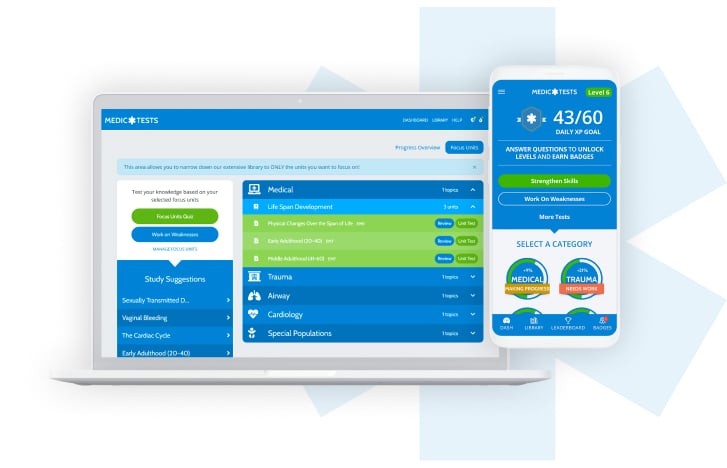
It doesn’t matter what app you ended up choosing , use it to study.
For example, maybe you took the exam and got a 95% on medical/ OB questions, but 48% on trauma.
Now you can spend most of your time on trauma.
Because learning anything else about OB in this case is almost pointless. Going from 95-98% gets you almost nothing on the actual NREMT exam.
But going from 48% on trauma to 83% is the difference between failing and passing.
So, when you schedule your time to study, always prioritize your weak spots.
Otherwise you’re wasting precious time.
With 80% of your time being spent on pumping up your weak spots, what do you do with the other time?
Practice answering questions.
Because you just learned the NREMT is weird.
The answers aren’t always straight forward. The questions get asked in weird ways.
Now let’s cover some question answering tips that will stop you from being confused on your next attempt.

How to Read a Question
There are four steps to breaking down an NREMT question.
I found them really useful to see exactly what the test was trying to get at.
If I knew what they were actually asking, getting to the right answer became a lot easier.
They are
- Asses Mental Status
- Critical Question Points
- Patient Complaint
- Evaluate Vitals
The first step is assessing mental status.
You get very little information on National Registry questions. The test makers often leave a lot out.
The one thing you almost always get is a clue on patients mental status.
You need to use those clues to hone in on treatment and transport decisions.
Second is critical question points.
These ones are dumb but you should never miss them.
It’s the age old “BSI comes first” answer. The first thing you do is always through on gloves and consider C-spine.
As long as you keep some critical failure points in mind, you shouldn’t miss any of these.
Next is patient complaint.
This is a little more obvious. You’re getting direct information from the “patient” themselves.
If the question gives you chief complaint, focus in on it.
Finally, evaluate vitals.
You won’t get vitals very often. But usually they make a question’s answer pretty cut and dry.
If you have a pressure of 76/44 I’d bet good money the question is related to shock.
The vitals are a dead give away.
Unlike patient complaints, vitals are completely objective. Just pure information for your question answering ease.
And if you want to dive deeper into question breakdowns, check out this article on Limmer Education.
Time For That Retake
The NREMT is a beast of an exam.
Thankfully there are a lot tools to help you beat it.
All you need is to find a good study app and learn to break down and answer questions.
Good luck on your next test!


 The Medic Mentor
Leave a comment