Is It Really That Hard To Become A Paramedic?
This article is going to cover all the biggest sticking points EMTs run into in paramedic class and how to get past them.
Yes…and no.
I want you to think about the worst paramedic you know.
The one you aren’t sure how they passed?
Yeah if they can make it so can you.
For sure, paramedic class is a lot of studying. 1200-1800 hours for your National Registry to be exact.
That’s way longer than EMT. An EMT-B only requires 120-150 to qualify for your NREMT exam. Some are as short as 4 weeks.
Paramedics take class for a minimum of 6 months. Most are 10-12 months. it really depends on the program you’re going through.
It seems like a lot but you have to remember. If you can pass your EMT you can pass your paramedic class.
If this is your first time here, hey, I’m Shay. I’m a firefighter paramedic and I’ve been working in pre-hospital EMS for over a decade now. I’ve also taught several EMT and Paramedic programs.
Today, I’m going to cover what makes paramedic class so hard and exactly how you can pass.
Time Commitment
Paramedic class takes a lot of time. We already established that.
Those 1200 plus hours? That’s about 40 weeks of 9-5 class work. Paramedic class literally becomes a full time job while you’re in.
But there are really two major time sucks.
One is the time you spend studying each day.
The second is clinical hours.
Daily Time
For almost the entire course, class is 8 hours a day.
Doesn’t seem that bad, right? Kinda like a normal day job.
The issue is you spend the whole day studying, learning, and practicing. I don’t care how smart you are, that’s a lot of brain power.
But then you get home.
No setting down work and just enjoying your night. Nope, you still have studying to do.
Studying has to fit in the rest of your day along with cooking, cleaning, and spending time with your family. Forget about relaxing. That’s over now.
There is so much to learn and so little time to master it.
It’s exactly why I went into paramedic class as early into my career as I could. I already knew I wanted to be a paramedic so I wasted no time. I was young. I didn’t have any kids yet and I was single.
It was literally the best time in the world to devote to paramedic class. I can’t imagine what is was like for people with families.
Honestly, I lucked out.
And we know time management is essential for success in anything you do. It’s doubly important here. Just going with the flow is setting yourself up for failure.
Get used to using your calendar.
Schedule everything. Add your study time, clinicals, and class time. And in those rare few moments you have nothing to do, schedule some hardcore relaxation. You can’t study 100% of the time.
Most importantly, follow that schedule.
I’m guilty of doing this all the time. I make a plan for the day. I wake up on time. Then I immediately don’t follow the plan.
Really derails my off time and I don’t get as much done as I’d like.
If you make a plan to study and completely ignore it, you basically just wasted all that time making a plan. Time you could have used to study more.
Clinicals
Clinical rotations are another huge time sink.
You aren’t even in class. And you can’t count on them being in that sweet 9-5 time schedule you had for studying.
You might even get stuck on a few night shifts with class in the morning. That’s not unusual but it sure does suck.
On the bright side, clinical hours are fun.
You’ll either be in the back of an ambulance or in the hospital. Paramedics can work in either environment so you need some practice at both.
Sometimes these shifts are slow which is an awesome little break.
But don’t get too relaxed. In those free moments you should be studying and writing reports. The more you can get done during those clinicals, the less you have to worry about at home.
It’s much nicer having free time at home than relaxing at the nursing station.
Study Habits
You already know how to study a bit from your EMT course.
Paramedic is just a more intense version of that. And you need to keep up the habit for longer.
Scheduling your study time is extremely important.
But knowing how to study might be even more important.
How to Study
You might have fine study habits already. I mean you obviously passed high school and EMT.
If they worked, great. You can skip this section and move on.
But I bet there’s room for improvement. Time to look for a better way.
And the biggest thing you can do to study more effectively is to focus. I don’t mean on a particular subject. I mean to shut out all other distractions.
I don’t care who you are. No one studies better with distractions.
People always say they work better with a show or something in the background. That is always untrue. Every study has shown that studying with TV or music in the background makes you less effective.
People who think they need this distraction to study actually don’t know how to focus.
They just want that distraction to entertain them.
It doesn’t make their studying “better”. It makes studying more fun.
So if you really want something in the background, try this. Find some music that you can throw on that has no lyrics. Then turn it down so you can barely hear it.
After 35 decibels, noise becomes a distraction.
I still think this makes your study time worse, but some people can’t shake the idea they NEED music. If that’s you, have at it.
Study Materials
There are a ton of different study materials out there you can use.
Normally, you want something that gives you feedback. Practice exams should give you a readout of all the things you missed. It should let you know why you missed a question and what topics you’re doing worst on.
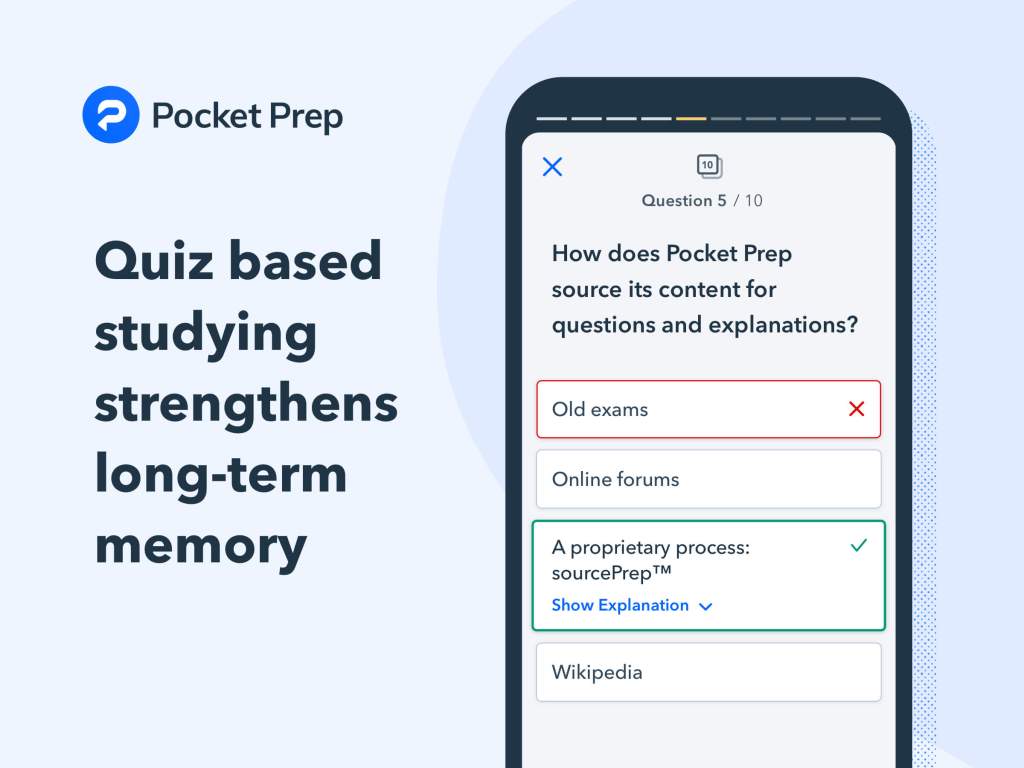
That’s why I like Pocket Prep
They have a great feedback system. You’ll know exactly what you’re missing so you can spend your time making the biggest gains before the NREMT.
Plus, they break down every question so you know exactly what you got wrong and why. That’s something you won’t find in many other programs.
And if you don’t like Pocket Prep, I have a full list of resources I recommend. Check them out here.
Study Guides
Having a good study guide is a great way to prepare for class.
But they can cover thousands of pages of material. Even if you distill that down to 10% of the information you’re still looking at 100 pages. That’s too much.
Start making your own study guides.
This works best if you have a good practice exam like the one above. You use the feedback from the practice tests to make study guides focused on exactly what you need to brush up on.
I have a full guide to study guides here.
- Study guides are great
- Focus on material you don’t know
- But you can make your own
- Works best with practice tests(like one above)
- If you want a detailed list on making study guides check this out
National Registry
The National Registry is required for your paramedic license just like for EMT.
But recently the exam has changed. If it’s been over a years since you took yours, it’s going to look a lot different.
New Test
The new NREMT-P exam has a few major changes.
Basically, the test is longer, more accurate, and takes more critical thinking than ever before.
The test has new question types like drag and drop, and sequence ordering.
Oh, and the weirdest part is, no more physical skills portion.
NREMT exams used to be super confusing and would ask questions in unintuitive ways. The new test tries to change that. The questions are more in line with what you will actually see in the field.
Long story short, anything your old, salty medic partner says about the test is out of date.
You’ll have to study for a whole new test now.
You’ve Got This
Yes, paramedic class is hard.
It takes longer to finish.
You have to study more.
But remember, the worst medic you’ve ever met passed their class. You better believe you can too.


Leave a comment